Sunday, May 17, 2015

REJECTED AND DEJECTED


I thought i would share with you some staged shots of the new bits that have progressed a little more since last post.Although only in 2 D its the best i can do.
3 D would have been possible at the Thornleigh Exhibition this June but my offer to exhibit was unfortunately declined .
It was explained that although the layout was incomplete,it would be used as a shuttle service with suitable rail-motor traveling around the finished sections .
With the balance showing how to progress from steel and foam to finished product.
Or as a clinic called ,how to stop dreaming ,get off your ass and make a layout.
This obviously wasn't seen to be in the best interests of the hobby or the organizers.
But with  every bad situation there is always a positive and my positive is I will save myself a grand by not having to drag the new bits to Sydney and back.


Sunday, March 1, 2015

BIG NEWS


There has been some action over the last 2 Sundays on the new bits.Which haven't really changed much in a long time.
But with the collection  of some appropriate soil to provide the transition from Mungindi black soil to Ashford style dirt.I decided that some scenery was in order.And might i say the transformation in such a short space of time is very exciting indeed.
Just got the basics at this stage but some baby photos are in order.


                                            Double 44's do the honours crossing the road
                                                 entrance to the Ashford silo complex.


                                                          Moving across Gill Gill Creek


                                              Once across the watercoarse a small cutting .


                             On the inside of the curve cattle struggle through the drought conditions
                               And on the other side a ploughed paddock awaits the rains


                                           And of course the trains heading from Mungindi to Ashford


 For some before pics
http://bolivanswgr.blogspot.com.au/2010/12/christmas-report.html


                                NOT AN ARMY TRAIN IN SIGHT !!!!!!!!!!!!

Sunday, February 8, 2015

IRONING OUT SOME PROBLEMS


Well after looking at the latest AMRM it has got to a stage when something must be said and done regarding the constant disregarding of certain rules as applied to modelling.
For some that count rivets and perhaps dwell on the shape and curve of the 42 class nose, or the correct shade of green for a 38, when it comes to modelling a corrugated iron roof all common sense and intellect built up over years surviving on the planet are carelessly thrown out the window and the raving lunatic personality from within takes control like a bad scene from Alien.
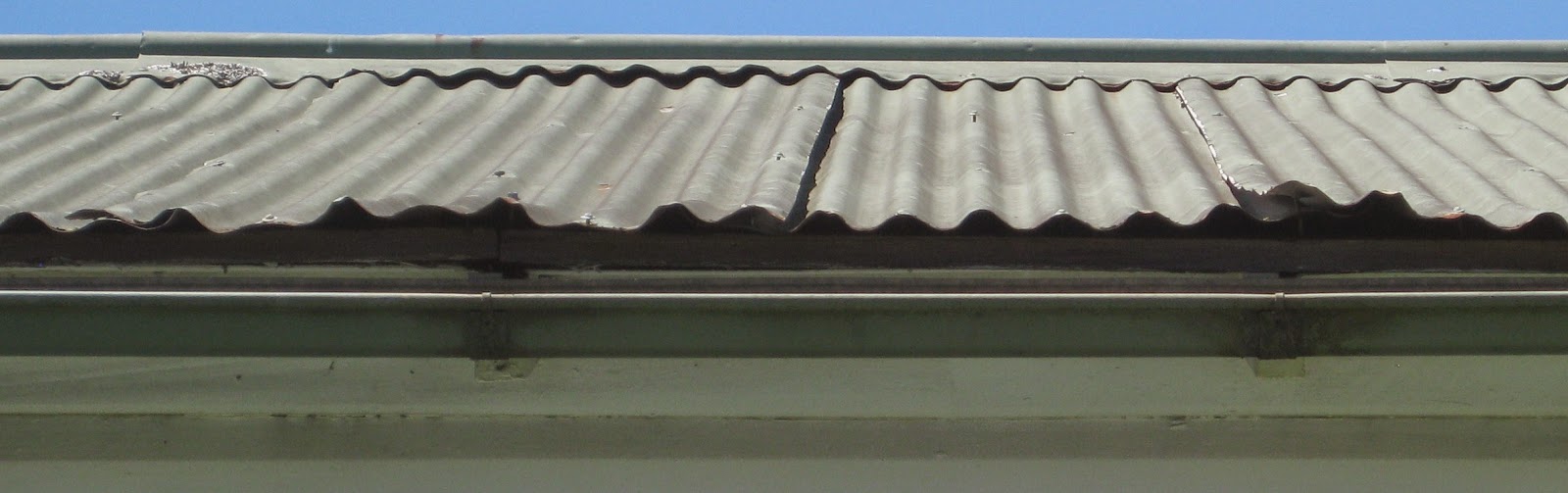
This results in atrocious looking structures that look nothing like the real thing, all based on the pretense that if a corrugated iron roof is constructed in real life with individual sheets then the best way to model this would be to use individual sheets
NO ITS NOT !
Most layouts are built too low, giving the impression of the view from a plane, so getting the roof right is more important than ever.
Please allow me to explain.


A quick lesson in some of the finer points of corrugated iron.

Galvanised iron's introduction to Australia dates back to 1837 with the introduction of corrugating and curving machines around this date to various states and also imported iron from England being used. Imports for 1894 totalled 170,000 tonnes.
With its acceptance and easy use making it widely used around Australia in ever increasing quantities.
As with any new invention it took a while for the  most acceptable style or design to become entrenched and dominate (Hands up all those BETA and 8 track owners).
By the 1890's the common pitches available were 3, 4 and 5 " of varying thicknesses, with each manufacturer having a small variation in pitch and depth.
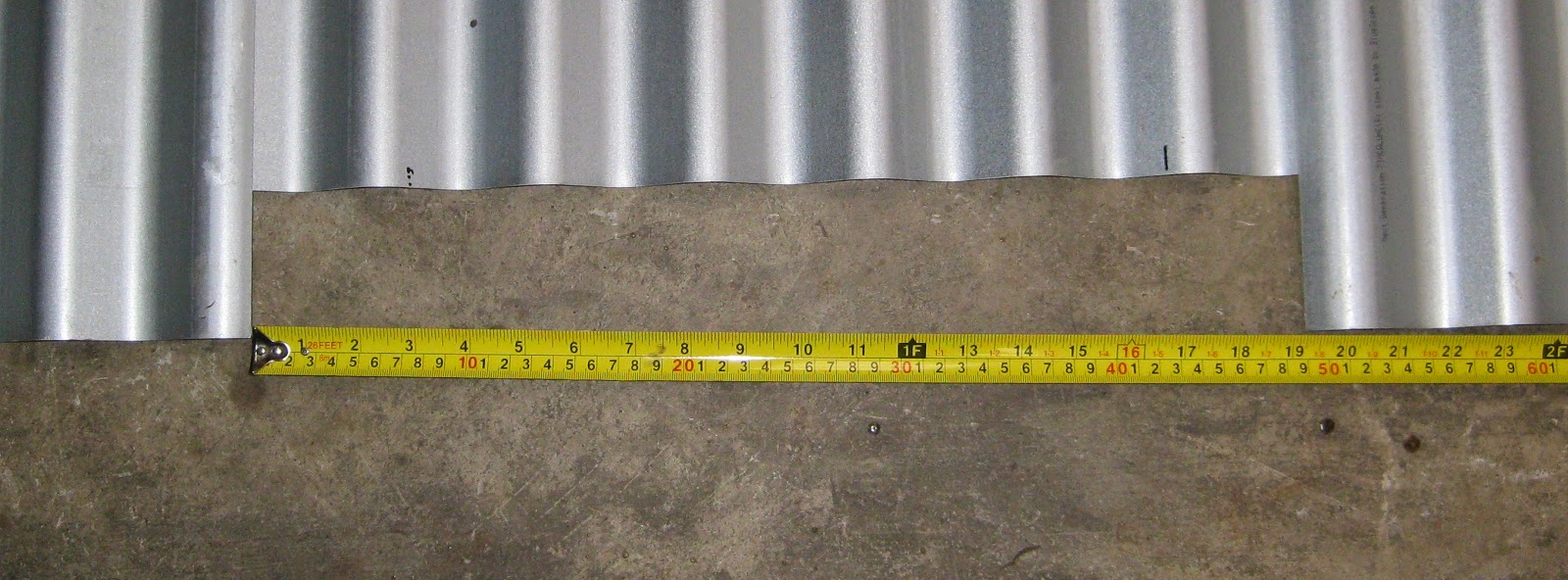
The one we shall deal with is the overall winner of the standardisation contest being the 8/3 inch corrugations, meaning the sheet had 9 high corrugations at 3 inch centres and 8 low corrugations or valleys at 3/4 inch depth, with each side of the sheet having a downturn.  The sheets came in 5, 6, 7, 8, 9 and 10 ft lengths and could be 18/20/22/24/26/28 in gauge or thickness.
This early iron was a more ductile than the present hi-tensile iron used today for roofing
The most common gauges used were 26 for roofing with the heavier 24 used for curved bullnose verandas, veranda awnings and 22 or 24 gauge for tank making. The lighter 26 gauge could not be curved.

The Birmingham Gauge used for this standard is not the same as the Birmingham wire gauge.
With every 6th decrease in the gauge number giving a doubling in sheet thickness .


 Because these 8 corro sheets had a down turn on both sides as opposed to 1 down and 1 up as with the current 10 and a half corro sheet used today (more on this latter), for cladding a wall 1 corrugation of lap was adequate. But for roofing to be water proof  1 1/2 corrugations was acceptable but 2 was extravagant.
To sheet a roof and have enough lap on the sides of the sheets to be weather proof, 2 methods where used which gave 2 very different appearances .


Method 1
The old 1 over and 1 under trick meant that every alternate sheet was turned over so as to give 1 1/2 corrugations of lap.With the under sheet showing a much narrower width than the  next  full over sheet.


                                    So the full width over sheet would show 660mm or 2' 6"
                                     And the under sheet would show 490mm or 19 and 1/4 "


Method 2
 The sheets are laid from one direction with one side of the sheet being an under the other side being an over or 2 corrugations of lap. This gives a more uniform (in sheet width) roof appearance.
The direction of the overlap can be determined by the prevailing weather or the viewing direction so as not to see all the side laps or just the easiest direction to put on the sheets.


                                         So each sheet would show 525mm or 20 and 5/8 "


                      Some of the more astute viewers would recognise this as the local G I cop shop roof.

With the introduction of the wider 10 and 1/2 corro sheets possibly around the 1950's things change in the overall look of a roof. These sheets have 1 up and 1 down corrugation on the sheet sides, so that 1 1/2 corrugations of lap are able to be used. With the overall sheet width of 860 mm and a cover of 760 mm being visible on the finished roof. These sheets were originally available in standard increments of 1 ft in lengths up to 10 ft. But now the delivered length is only restricted to your ability to transport the length legally.
As for the cover show on the length of the sheets. The lap would be at least 6 " so 2 x 8 ft  sheets would cover 15 ft 6" not 16 ft.


Bullnose verandas still use the same 8 corro sheet of a thicker curving grade, but used only 1 corrugation of lap which was usually riveted together  .


                       So the sheet would show 23 and 5/8" or 600mm


                               Which brings us back to the modelling of roofs correctly. (Remember)


As with any modelling, a time period needs to be determined not only for the roofs initial construction but more importantly the era being modelled. For an example, a roof installed in 1910 but modelled for 2010 would be in a poor condition.and probably painted. If an unsupported bullnose veranda is on this building the iron would be pushed down and out of shape usually from fat arsed painters using it for a scaffold without a plank or stepping down on to it from the main roof. But if the same roof is modelled for 1920 it would be near new and unpainted. Plus what width and length of sheeting to be shown ?
One must remember that when installing individually cut sheets on a model that if the sides or ends of the sheet stick up more than .5mm the real life sheet would be sticking up 1 3/4 ". This does not represent normal old roofs but an abandoned house with a roof ready to be blown away. This was the main reason for this post to stamp out this ridiculous practice once and for all.
When  modelling roofs I like to use corrugated card or aluminium sheets to cover the entire area then mark out the width and length of sheet.being modelled. Then using a fine pencil draw in the lines or lightly scribe with an exacto knife.


                               The roof of my A depot modelling 10 and 1/2 corro 7 ft sheeting  


        I don't attempt to model loose sheets on in-use buildings as the dimensions are just to small .   And don't forget to get the ridge, valleys and barge rolls the right length too !


e

Sunday, November 30, 2014

LIFES A CIRCUS.


I have been attending the meetings at Bloggers Anonymous or BA as we call it,one a regular basis.It turned out to be BS.
As apposed to AA meetings which sound like a great way to meet like minded individuals in a relaxed and friendly atmosphere.
Its been 14 months since I last Blogged,and although the therapy was good ?
Well when I say therapy,it consisted of electrodes attached to ones genitals and every time they showed you a picture of a train a small electric charge was administered along with a smack over the back of the head with a fence palling. 
Well I have busted out.!
BOLIVIA did attend the EPPING MODEL RAILWAY clubs exhibition back in June.
Which was a nice day out for all concerned.
Peter Sanderson came from Brisbane to help with train dispatch work as did Dale Richards from Canberra who was quite happy to be the fat controller all weekend.
Although the team is very widely spread when needed we can all pull together and come as one.

On of the highlights for me was the running of the WIRTHS CIRCUS TRAIN on BOLIVIA
Peter Sanderson constructed all the wagons .And although they dont get to see the light of day very often they are fantastic.
Or Maybe its just me ,as not to many people commented on the train.
But the best way to see is the 2 videos below
The train was run in 2 divisions as per normal operation on the NSWGR at the time .
 Remember this train travelled the state regularly from town to town.With everything needed to put on a show.


                                                                   The 1st division


                                                                    The 2nd division 


It was also decided at the BOLIVIA meeting to change the header picture every time a new Blog is posted .
As apposed to the change at New Years ,which was obviously missed last time.With a  description under the picture.

Monday, October 7, 2013

CATCH UP

Have been doing a lot of stuff lattely.
No 1, I went to Lismore to get my Birthday present the other week .Which was a ride in a L-39 jet.
Now most people have seen Top Gun ,and a flashy nickname seems to be the fashion if one is involved flying in the jet fighter industry.
I had lots to chose from Maverick.Iceman , Goose was suggested  .
Well actually the one that would seem to fit perfectly after the event would be Chuck Chunder.


Well that was last years present, and the week before that I had to go to Tamworth to get this years present.
         A West Highland Terrier , which we have now brain washed into thinking his name is Jock .
                           Wee Jock is a bit of a socks and bras man ,cords, shoes and anything else.
                            Does anyone know where you can get the back half of a thong restored ?


     And before that  we ended up in tropical far North QLD for a conference at Townsville

And while we where there made the trip up to Atherton to see some relatives .Now if you haven't seen the sugar cane railways in action do yourself a favour and check it out.The length of the trains is one thing but some of the curves and grades in the highlands is amazing.

                                              The end of the train is disappearing on the far right 

                                    And then we had a sleeper on  the Sunlander back to Brisbane.
                                         The old QR moto     I"ll walk beside you, is very true.


And of course this weekend a trip to Liverpool.Got to Ardglen on Friday night to see a coalie going over the top with three 82 bankers which stopped in the loop to allow a wheat to pass, then restart on the grade with no problem at all .Camping on Friday night in the swag near the old BP depot at Scone for some up close train action.I knew they sifted a bit of coal out of the Gunnedah basin, but on Friday night there must have been 6 coal trains heading north, all triples with about a 100 wagons, 2 wheats + the cotton container train . And the Up trains heading the other way.Very busy line.Got some shots in the morning around Muswellbrook before heading to Penrith to scan some pictures of transformer wagons and out of gauge stuff.


Attended the exhibition on Sunday after church of course !
Well its more of a shop expo isnt it .Which is good for all us red necks that dont get to the city too often
Every thing in one spot.They could look at incorporating some layouts into the shop fest as well.

Good points
1 Good quality food for a change most exhibitions have the idea that the best way to feed the masses is to fry everything or give them pies and soft drinks
2 Excellent parking and attendants
3 Lots of shops

Bad points

Whose idea was it to put layouts in that tent out the back on that springy arse floor that turned into a sauna for those poor unfortunate bastards that had to be out there.
Maybe now its the year 2013 the organizer could shell out a bit more of the $14 they charge to get in towards air conditioning. I've camped in some shity shearing sheds but that tent would have to take the cake for an event held in the states capital.
Possibly the state goverment  had to offset their carbon credits, so the fire works could go ahead on the harbour that night ?
LAYOUTS, get some layouts to attend .
Pay some money for the entertainment that brings in the revenue and organize some F%@#^&!en layouts.Crying poor and not wanting to part with any of the door money is not really a good excuse.
Most good layouts would attend. But don't expect them to subsidise the clubs profit margin. I for one have never been asked to go to Sydney without the proviso that I spend a couple of thousand to cover my expenses and time ;and be happy with a hot dog voucher for lunch from the organizers as a 'feel good' incentive.

Back to the trains
Went into Newcastle on the way back to check out the action. Sunday afternoon  going to the coal loader the trains where nose to tail. If anything happens to this line or bridge like up at Breeza , the whole states coal industry would shut down I'm sure.

I did notice for any purchaser of the Auscision coal wagons that the wagons from Gunnedah have a different loading to the Hunter trains. Probably to do with the axle loads. And of course the colouring of the inside of the wagons


                                        Wagons from the north west,with probably 2/3's loading


                                                  Wagons from the Hunter 100% loaded


 An empty very shiny wagon .And it looks like the doors don't shut properly either, spreading coal into the ballast .

      This is a major problem for the perway in the Powder River Basin in the States and I suppose in the Hunter too.


Got to Scone to my camp and had  no problems with parking. I cant believe such a good spot and no one else is ever there!
On Monday headed home only saw a coaly coming out of the Ardglen tunnel and then followed the bankers back to Willow Tree.


And now am back in no train territory.
Apart from the pretend ones that is !